
AI Strategy for SMEs Training
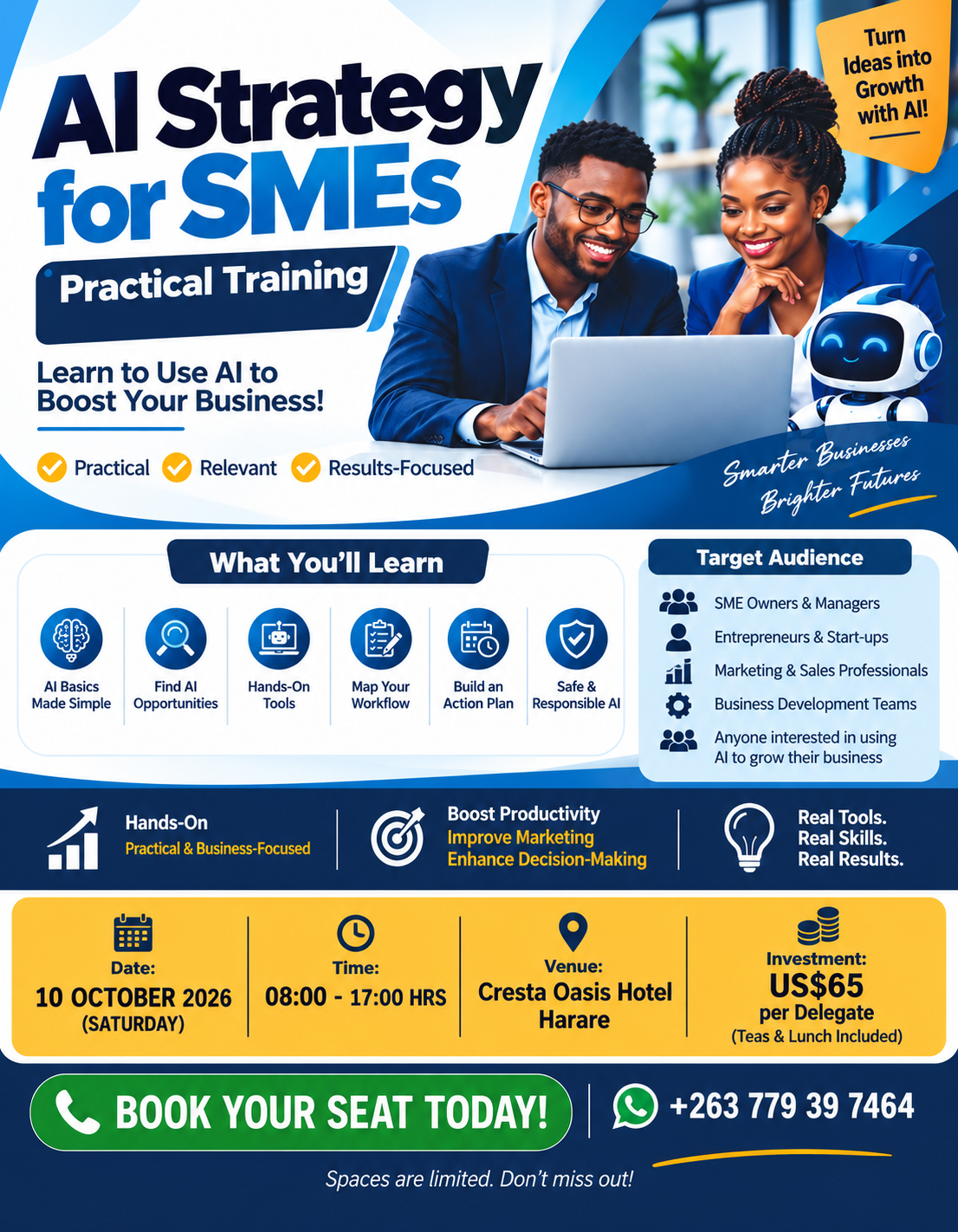
AI Strategy for SMEs
To register Contact +263779397464
Email Us
Practical AI Adoption for Business Growth, Efficiency and Competitiveness
About the Workshop
Artificial Intelligence is transforming the way businesses operate, communicate, market, analyse information, and make decisions. While large corporations are rapidly adopting AI technologies, many Small and Medium Enterprises remain uncertain about where to begin and how AI can realistically create value within their organisations.
This practical consultant-led workshop is designed specifically for SME owners and managers who want to understand how Artificial Intelligence can improve business efficiency, productivity, customer engagement, marketing, reporting, and decision-making.
The programme combines practical demonstrations, hands-on exercises, business assessments, AI opportunity mapping, and strategic planning sessions to help participants identify realistic AI opportunities within their businesses and begin building a practical AI adoption strategy. The full-day structure allows more time for demonstrations, guided practice, readiness assessment, and development of a practical implementation roadmap.
Who Should Attend?
- SME owners and entrepreneurs
- Managing directors and business leaders
- Operations managers
- Finance and administration managers
- Marketing and business development managers
- Professionals interested in AI-driven business transformation
Why Attend This Workshop?
- Understand AI in simple business language
- Learn how SMEs can practically use AI
- Experience live demonstrations of leading AI tools
- Assess your organisation’s AI readiness
- Identify opportunities for AI adoption within your business
- Develop a simplified AI strategy for your organisation
- Learn how to improve efficiency and competitiveness using AI
| DETAILED SESSION OUTLINE |
| Time | Programme Activity |
| 0800hrs – 1000hrs | Session 1: AI Fundamentals for SMEs and the Future of Business |
| 1000hrs – 1030hrs | Tea Break |
| 1030hrs – 1300hrs | Session 2: Hands-On AI Productivity and Business Applications |
| 1300hrs – 1400hrs | Lunch Break |
| 1400hrs – 1530hrs | Session 3: SME AI Readiness Assessment and Opportunity Mapping |
| 1530hrs – 1700hrs | Session 4: Building an AI Adoption Strategy for SMEs |
Session 1: AI Fundamentals for SMEs and the Future of Business
Time: 0800hrs – 1000hrs
This session introduces participants to Artificial Intelligence from a practical business perspective. The focus is on demystifying AI, creating urgency, demonstrating early practical use cases, and helping participants understand how AI can create immediate value within SME environments. It also explains why AI should be treated as a business capability rather than merely a collection of tools.
- Understanding AI in simple business language
- AI myths versus reality
- AI versus automation and digitalisation
- Why SMEs cannot ignore AI
- How AI is changing customer expectations, productivity and competitiveness
- 10 ways SMEs are already using AI or AI-enabled tools without realising it
- AI opportunities for customer communication, marketing, reporting, administration, proposals, quotations and decision-making
- Human + AI collaboration: using AI as a business assistant rather than a replacement for judgement
- Introduction to selected AI tools through simple business examples
| AI Tool / Tool Category | How It Will Be Introduced in Session 1 |
| ChatGPT, Claude, Gemini and DeepSeek | Introduced as general-purpose AI assistants for writing, planning, brainstorming, summarising, customer communication, proposals and productivity support. |
| Microsoft Copilot | Introduced as productivity support within Microsoft 365 applications, including Word, Excel, PowerPoint and Outlook where available. |
| Perplexity | Introduced as a research and information discovery tool for market scanning, competitor research and business question answering. |
| NotebookLM | Introduced as a tool for summarising and interrogating business documents, reports and reference materials. |
| Demonstration Area | Example Activity |
| Business Communication | Drafting professional emails, customer replies and follow-up messages. |
| Research and Market Scanning | Using AI to gather structured information for business planning, competitor monitoring and opportunity identification. |
| Document Summarisation | Summarising business reports, policies, meeting notes or reference documents into clear management points. |
| Idea Generation | Generating business improvement ideas, customer service scripts and operational checklists. |
Session 2: Hands-On AI Productivity and Business Applications
Time: 1030hrs – 1300hrs
This session gives participants deeper hands-on exposure to practical AI tools and their use in everyday SME operations. The emphasis is on applying AI to real business tasks rather than learning tools in isolation. Participants will learn how to frame business problems, give clear instructions to AI tools, refine outputs, and use AI responsibly for productivity and business communication.
- Practical prompt engineering for business users
- How to ask better questions and give AI useful context
- Role-based prompting for managers, marketers, administrators and business owners
- Using AI for customer communication, marketing, proposals, quotations, reports and presentations
- Using AI to support spreadsheet interpretation and management reporting
- Understanding the difference between first draft output and final business-ready work
- Common mistakes beginners make when using AI tools
- Live demonstrations and guided participant exercises
| Demonstration Area | Example Activity |
| Business Communication | Drafting professional emails, customer replies, apology messages, follow-up messages and customer engagement scripts. |
| Marketing and Sales | Creating social media content, adverts, product descriptions, campaign ideas and promotional messages. |
| Proposals and Quotations | Using AI to structure business proposals, quotation text, tender responses and client-facing documents. |
| Reporting and Analysis | Summarising data, interpreting spreadsheet information and preparing management reports. |
| Presentations | Creating presentation outlines, pitch decks and visual storylines using AI presentation tools. |
| Design and Visual Content | Using Canva AI to develop flyers, adverts, social media designs and simple promotional visuals. |
| AI Tool / Tool Category | Typical Business Use in Session 2 |
| ChatGPT, Claude, Gemini and DeepSeek | Writing, planning, brainstorming, summarising, customer communication, proposals and productivity support. |
| Microsoft Copilot | Productivity support within Microsoft 365 applications, including Word, Excel, PowerPoint and Outlook where available. |
| Canva AI | Designing adverts, flyers, social media graphics and marketing visuals. |
| Gamma | Creating business presentations and pitch decks quickly. |
| Other Productivity Tools | Selected tools for workflow automation, meeting summaries, content creation and business efficiency. |
Session 3: SME AI Readiness Assessment and Opportunity Mapping
Time: 1400hrs – 1530hrs
This session helps participants evaluate the readiness of their businesses for AI adoption. Participants assess current systems, capabilities, operational challenges and opportunities where AI can create business value. The session is designed as a simplified consulting-style diagnostic rather than a technical audit.
- What makes a business AI-ready
- Common barriers to AI adoption in SMEs
- Digital systems and process maturity
- Business data availability and quality
- Staff digital capability
- Repetitive operational tasks and bottlenecks
- Customer engagement systems and reporting practices
- Leadership readiness and openness to innovation
- Workflow mapping and AI opportunity identification
- Prioritising high-impact, low-cost and quick-win opportunities
| Assessment Area | What Participants Consider |
| Digital Systems | How much of the business is already digital rather than paper-based or informal. |
| Data Availability | Whether the business collects usable customer, sales, finance, operations or service data. |
| Staff Capability | Whether staff can confidently use basic digital tools and follow structured workflows. |
| Repetitive Tasks | Tasks that consume time repeatedly and may be suitable for AI support or automation. |
| Customer Engagement | How customers communicate with the business through WhatsApp, email, phone, social media or walk-ins. |
| Reporting and Decisions | Whether management reporting is manual, delayed, inconsistent or data-driven. |
| Leadership Readiness | Whether owners and managers are willing to adopt, govern and invest in AI responsibly. |
| Participant Exercise | Expected Output |
| AI Readiness Self-Assessment | A simplified readiness score showing current strengths, gaps and priority areas. |
| Workflow Mapping | A list of key business processes where AI may reduce time, improve quality or support better decisions. |
| AI Opportunity Mapping | A prioritised list of practical AI opportunities based on effort, cost and expected business value. |
| Group Discussion | Shared examples across sectors such as retail, services, NGOs, manufacturing, education, transport and professional services. |
Session 4: Building an AI Adoption Strategy for SMEs
Time: 1530hrs – 1700hrs
This session guides participants through the development of a practical AI adoption strategy tailored to their businesses. The emphasis is on realistic implementation rather than theoretical planning. Participants are guided to select practical tools and actions that match their business objectives, current readiness level and resource capacity.
- Aligning AI with business objectives
- Identifying practical quick wins
- Prioritising AI opportunities
- Selecting appropriate tools
- Managing data privacy, misinformation, confidentiality and overdependence risks
- Developing 30-day and 90-day implementation actions
- Defining success measures such as time saved, faster response, improved reporting or increased leads
- Introducing basic AI governance rules for SMEs
- Developing an action-oriented AI adoption roadmap
| Strategy Component | Participant Output |
| Business Challenges | The key operational, marketing, reporting or customer service challenges the business wants to solve. |
| AI Opportunities | The specific processes or tasks where AI can realistically assist. |
| Priority Tools | A short list of tools to test and adopt first. |
| Quick Wins | Immediate actions that can be implemented within 30 days. |
| 90-Day Actions | Medium-term actions for improving workflows, staff capability and reporting. |
| Risks and Governance | Basic rules for responsible AI use, confidentiality, human review and data protection. |
| Success Measures | Simple indicators for monitoring whether AI is producing value. |
| TOOLS, METHODS AND TAKEAWAYS |
AI Tools to be Introduced
The introduction of tools will be spread across the first two sessions. Session 1 introduces selected tools at a strategic and conceptual level so that participants understand their business relevance. Session 2 provides deeper hands-on demonstrations and guided practice using the same tools in practical SME scenarios.
| Tool | Typical Business Use |
| ChatGPT, Claude, Gemini, DeepSeek | Writing, planning, brainstorming, summarising, customer communication, proposals and productivity support. |
| Microsoft Copilot | Productivity support within Microsoft 365 applications, including Word, Excel, PowerPoint and Outlook where available. |
| Canva AI | Designing adverts, flyers, social media graphics and marketing visuals. |
| Gamma | Creating business presentations and pitch decks quickly. |
| Perplexity | Research support, market scanning and information discovery. |
| NotebookLM | Summarising and interrogating business documents, reports and reference materials. |
| Other Productivity Tools | Selected tools for workflow automation, meeting summaries, content creation and business efficiency. |
Participant Requirements
- Laptop computer
- Basic familiarity with email, internet browsing and Microsoft Office
- Existing business process information where available
- Willingness to participate in practical exercises and discussions
Participant Takeaways
- AI Readiness Assessment Tool
- SME AI Adoption Strategy Template
- AI Prompt Guide
- AI Tools Directory
- AI Implementation Checklist
- AI Governance and Risk Checklist
- Workshop reference materials
Expected Outcomes
- Understand how AI can create business value
- Identify realistic AI opportunities within their organisations
- Gain practical exposure to AI tools
- Develop a simplified AI adoption roadmap
- Understand the first steps toward AI implementation
- Appreciate the risks and responsibilities associated with AI use in business
About the Facilitator
This programme is facilitated by experienced business, analytics and AI consultants with practical expertise in data analytics, business strategy, digital transformation, SME advisory services, market research, AI implementation and productivity solutions.
Value Proposition for SMEs
The workshop is designed to help SMEs move beyond curiosity and hype. Participants are guided to think strategically about AI by first identifying business problems, then selecting practical tools and actions that support growth, efficiency and competitiveness. The result is a clear starting point for responsible AI adoption rather than a confusing list of tools.