Blog

Zillow’s US$500 Million AI Failure: What Every Business Should Learn About Predictive Analytics

Zillow

Zillow’s US$500 Million AI Failure: What Every Business Should Learn About Predictive Analytics

Artificial intelligence (AI) and predictive analytics are transforming how organisations make decisions. From forecasting sales and detecting fraud to optimising supply chains and assessing credit risk, predictive models are increasingly becoming the backbone of business strategy. However, one of the most expensive AI failures in recent history demonstrates that algorithms are not always right.

The collapse of Zillow Offers, the AI-driven home-buying service launched by Zillow, offers a powerful lesson for businesses seeking to adopt AI and predictive analytics. The company lost more than US$500 million after its algorithms misjudged housing prices, ultimately forcing it to shut down the programme in 2021.

The failure highlights an important reality: predictive analytics can create significant value, but it can also generate significant losses when models are inadequately validated under volatile conditions.

What Was Zillow Offers?

Zillow Group launched Zillow Offers in 2018 as part of its ambitious strategy to transform the real estate industry through artificial intelligence.

The concept was simple. Instead of waiting for traditional buyers, homeowners could sell their properties directly to Zillow. The company would then use machine learning and predictive analytics to estimate property values, purchase the homes, make minor improvements, and resell them at a profit.

The initiative relied heavily on sophisticated algorithms that analysed massive volumes of data, including:

  • Historical property sales
  • Local market trends
  • Neighbourhood characteristics
  • Economic indicators
  • Property attributes
  • Buyer demand patterns

The company’s leadership believed that artificial intelligence could accurately forecast housing prices at scale and create a more efficient, technology-driven real estate market.

Initially, the concept appeared promising.

However, the housing market proved far more unpredictable than the algorithms anticipated.

How Zillow’s AI Misjudged Housing Prices

The global economy experienced extraordinary disruptions during the COVID-19 pandemic. Housing markets became increasingly volatile as consumer behaviour, interest rates, migration patterns, and economic conditions changed rapidly.

The predictive models used by Zillow struggled to keep pace with these unprecedented market dynamics.

The algorithms consistently overestimated future housing prices and purchased thousands of properties at inflated values. Instead of generating profits, the company found itself holding homes that could only be sold at significant losses.

By November 2021, Zillow announced the closure of Zillow Offers, reporting losses exceeding US$500 million and laying off approximately one-quarter of its workforce.

The failure became one of the most widely cited examples of predictive analytics gone wrong.

Why Did Zillow’s Predictive Analytics Fail?

1. Overreliance on Historical Data

Artificial intelligence systems learn from historical information. However, historical patterns are often poor predictors during periods of unprecedented change.

The pandemic fundamentally altered market behaviour in ways that historical datasets could not adequately capture. When conditions deviate significantly from past experiences, predictive models may become unreliable.

Businesses should remember that historical data is useful, but it cannot always predict the future.

2. Failure to Account for Market Volatility

Real estate markets are influenced by numerous factors that change rapidly and unpredictably, including:

  • Interest rates
  • Inflation
  • Government policies
  • Consumer confidence
  • Migration patterns
  • Economic uncertainty
  • Labour market conditions

Predictive models that perform effectively under stable conditions can deteriorate quickly when markets become volatile.

AI models are not immune to economic shocks.

3. Scaling Small Errors into Massive Losses

A small pricing error on one property may not appear significant. However, when an organisation applies the same model across thousands of transactions, minor inaccuracies can translate into enormous financial losses.

This is precisely what happened at Zillow.

The company made large-scale purchasing decisions based on predictive outputs that contained systematic valuation errors. The result was a loss of more than half a billion dollars.

The lesson is clear: small model inaccuracies can become catastrophic when decisions are automated at scale.

4. Insufficient Human Oversight

Artificial intelligence is a powerful decision-support tool, but it should not replace human judgement entirely.

Real estate valuation involves qualitative considerations that algorithms may struggle to understand, including local market sentiment, changing buyer preferences, and contextual economic developments.

Human expertise remains essential in interpreting model outputs, challenging assumptions, and identifying anomalies that machines may overlook.

Why This AI Failure Matters Beyond Real Estate

The failure of Zillow Offers is not simply a real estate story. It is a business lesson that applies to every industry embracing predictive analytics and artificial intelligence.

Today, organisations use predictive models for:

Financial Forecasting

Businesses rely on AI to predict revenue, expenses, and market performance.

Customer Demand Forecasting

Retailers and manufacturers use predictive analytics to anticipate future demand and manage inventory.

Credit Risk Assessment

Financial institutions increasingly depend on algorithms to evaluate borrowers and make lending decisions.

Insurance Pricing and Underwriting

Insurers use predictive models to assess risk and determine premiums.

Fraud Detection

Banks and payment platforms use machine learning to identify suspicious activities.

Human Resource Analytics

Organisations use AI to predict employee turnover and optimise workforce planning.

Across all these applications, one principle remains constant: predictive analytics is only as reliable as the assumptions, data, and conditions under which the models operate.

Lessons for Organisations Implementing AI and Predictive Analytics

Continuously Validate Predictive Models

Model performance should never be assumed to remain constant.

Predictive systems require continuous monitoring, recalibration, and validation to ensure they remain accurate as conditions evolve.

Stress-Test Models Under Different Scenarios

Organisations should evaluate how predictive models perform during:

  • Economic downturns
  • Market disruptions
  • Regulatory changes
  • Supply chain shocks
  • Extreme demand fluctuations

Scenario analysis helps identify vulnerabilities before costly failures occur.

Maintain Human Oversight

The most successful organisations use artificial intelligence to augment human decision-making rather than replace it entirely.

Experts should continuously challenge algorithmic recommendations and assess whether outputs remain reasonable under changing conditions.

Establish Strong AI Governance

Responsible AI implementation requires governance structures that address:

  • Data quality management
  • Model risk assessment
  • Accountability frameworks
  • Ethical considerations
  • Validation procedures
  • Performance monitoring

Without proper governance, organisations risk making strategic decisions based on flawed assumptions.

Prepare for Model Failure

No predictive model is perfect.

Businesses should develop contingency plans that allow them to respond quickly when algorithms perform poorly or when market conditions change unexpectedly.

The Real Lesson from Zillow’s US$500 Million Loss

The collapse of Zillow Offers does not mean that artificial intelligence or predictive analytics are ineffective. On the contrary, predictive analytics remains one of the most powerful technologies available to modern organisations.

However, the case demonstrates that AI should never be treated as an infallible oracle.

Markets are dynamic.

Human behaviour changes.

Economic shocks occur.

Data becomes outdated.

Assumptions fail.

Successful organisations understand that artificial intelligence works best when combined with rigorous validation, human expertise, and effective governance frameworks.

The companies that derive the greatest value from AI will not necessarily be those with the most sophisticated algorithms. They will be the organisations that understand both the capabilities and the limitations of predictive analytics.

The US$500 million failure of Zillow Offers serves as a reminder that AI can make organisations smarter, but only when businesses remain vigilant, continuously validate their models, and recognise that uncertainty can never be completely eliminated.

In the age of artificial intelligence, perhaps the most important lesson is this: technology can support decision-making, but sound judgement and robust governance remain irreplaceable.

Excel Automation: What It Involves and What It Means for Your Business

excel automation

Excel Automation: What It Involves and What It Means for Your Business

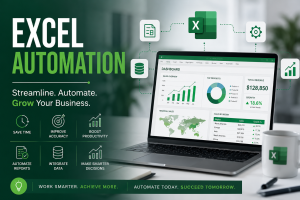
Excel Automation

Excel Automation is there for you because Excel Is More Than a Spreadsheet

Excel automation makes Excel do more for your business, saving time increasing efficiency and accuracy and allowing you to focus on productivity. For many businesses, Microsoft Excel is simply a tool for entering data, performing calculations and creating reports. However, modern Excel has evolved into a powerful automation platform capable of streamlining processes, reducing manual work and improving decision-making.

Excel automation involves using Excel’s advanced features and capabilities to automate repetitive tasks, integrate data from multiple sources, generate reports automatically and support business processes with minimal human intervention. When implemented correctly, Excel automation can significantly improve productivity, accuracy and operational efficiency.

The reality is that many organisations spend countless hours performing manual activities that could easily be automated. Employees often copy and paste data between systems, manually prepare reports, update dashboards and perform repetitive calculations. These activities consume valuable time that could otherwise be spent on strategic and value-adding tasks.

What Is Excel Automation?

Excel automation refers to the use of Excel’s built-in tools and programming capabilities to perform tasks automatically with little or no manual intervention. Rather than repeating the same activities every day, businesses can create systems that automatically:

  • Import and clean data
  • Perform calculations and analysis
  • Generate reports and dashboards
  • Send notifications and reminders
  • Update records
  • Produce forecasts and projections
  • Monitor key performance indicators
  • Create invoices and statements
  • Consolidate information from multiple files
  • Trigger business workflows

The objective of automation is simple: allow employees to spend less time performing repetitive administrative work and more time focusing on analysis, customer service and strategic decision-making.

Key Components of Excel Automation

  1. Formulas and Functions

Excel’s powerful formulas can automate calculations that would otherwise be performed manually.

Examples include:

  • Financial calculations
  • Commission calculations
  • Tax computations
  • Loan amortisations
  • Budget variances
  • Inventory reorder levels
  • Sales performance metrics
  • Forecasting models

Functions such as XLOOKUP, SUMIFS, COUNTIFS, IF, IFS, EOMONTH, INDEX and MATCH can automate complex calculations and eliminate manual errors.

  1. Data Validation and Automated Input Controls

Data validation can automate data entry processes by:

  • Restricting invalid entries
  • Creating dropdown lists
  • Standardising information capture
  • Preventing duplicate records
  • Reducing data entry errors

This improves data quality and minimises the need for data cleaning.

  1. Pivot Tables and Pivot Charts

Pivot Tables automatically summarise large datasets and transform raw information into meaningful insights.

Businesses can automatically analyse:

  • Sales by region
  • Customer trends
  • Product performance
  • Financial performance
  • Employee productivity
  • Operational efficiency

Pivot Charts further automate visual reporting and provide management with real-time insights.

  1. Dashboards

Excel dashboards automatically consolidate information from multiple sources and present it in an easy-to-understand visual format.

A dashboard can display:

  • Sales performance
  • Cash flow position
  • Outstanding debtors
  • Inventory levels
  • Customer satisfaction metrics
  • Project status
  • Operational KPIs

Instead of manually producing management reports every week or month, dashboards update automatically when data changes.

  1. Power Query

Power Query is one of Excel’s most powerful automation tools.

It automates:

  • Importing data from multiple files
  • Data cleaning
  • Combining datasets
  • Removing duplicates
  • Data transformation
  • Standardising information

For example, an organisation receiving daily sales files from different branches can use Power Query to consolidate all files into a single report automatically.

Tasks that previously took hours can be completed in seconds.

  1. Macros and VBA

Macros and Visual Basic for Applications (VBA) enable Excel to perform entire business processes automatically.

Examples include:

  • Generating invoices
  • Producing monthly reports
  • Sending email notifications
  • Updating databases
  • Creating contracts
  • Printing documents
  • Producing certificates
  • Processing payroll

With one button click, tasks that previously required dozens of manual steps can be completed automatically.

  1. Power Pivot and Data Models

Power Pivot allows organisations to analyse millions of records and create sophisticated business intelligence solutions.

It can automate:

  • Financial modelling
  • Budget analysis
  • Customer profitability analysis
  • Operational reporting
  • Management information systems

This turns Excel into a lightweight business intelligence platform.

Business Processes That Can Be Automated Using Excel

Finance and Accounting

  • Budget preparation
  • Cash flow forecasting
  • Financial reporting
  • Bank reconciliations
  • Debtors and creditors management
  • Payroll processing
  • Expense tracking

Human Resources

  • Leave management
  • Training records
  • Attendance registers
  • Performance management
  • Employee databases

Sales and Marketing

  • Sales dashboards
  • Commission calculations
  • Customer databases
  • Lead tracking
  • Marketing performance analysis

Operations

  • Inventory management
  • Project tracking
  • Production monitoring
  • Vehicle management
  • Procurement tracking

Real Estate and Valuation

  • Property databases
  • Valuation calculators
  • Tenant management
  • Lease administration
  • Property inspection schedules
  • Sales commission calculations

What Excel Automation Means for Your Business

  1. Significant Time Savings

Many repetitive tasks can be reduced from hours to minutes.

Activities such as:

  • Preparing reports
  • Consolidating data
  • Generating invoices
  • Updating dashboards
  • Calculating commissions

can be automated entirely.

Employees can then focus on higher-value activities.

  1. Reduced Human Error

Manual processes inevitably create errors.

Excel automation:

  • Eliminates repetitive data entry
  • Standardises calculations
  • Enforces controls
  • Improves accuracy

This leads to better decisions and greater confidence in organisational data.

  1. Improved Productivity

Automation allows employees to accomplish significantly more work with the same resources.

Rather than hiring additional staff to handle repetitive administrative tasks, organisations can increase output through process automation.

  1. Better Decision-Making

Automated dashboards and reports provide management with:

  • Real-time information
  • Performance trends
  • Early warning indicators
  • Predictive insights

Decision-makers no longer need to wait for month-end reports to understand business performance.

  1. Cost Savings

Excel automation reduces:

  • Administrative costs
  • Reporting costs
  • Labour costs
  • Error correction costs
  • Consultancy costs

For many small and medium-sized enterprises, Excel automation provides a highly cost-effective alternative to expensive enterprise systems.

  1. Improved Scalability

As businesses grow, manual processes become increasingly difficult to manage.

Automation allows organisations to:

  • Process larger datasets
  • Handle more transactions
  • Manage more customers
  • Produce more reports

without proportionately increasing administrative resources.

Is Excel Automation an ERP?

One of the most common questions businesses ask is whether Excel automation replaces an ERP system.

The answer is: not entirely.

Excel automation is ideal for:

  • Small and medium-sized businesses
  • Process-specific automation
  • Reporting and analysis
  • Custom solutions
  • Rapid implementation
  • Cost-effective digital transformation

ERP systems are more suitable when organisations require:

  • Enterprise-wide integration
  • Multi-user transactional systems
  • High transaction volumes
  • Complex approval workflows
  • Advanced security and governance controls

In practice, many organisations successfully use Excel automation alongside their ERP systems. Excel often acts as the analytical and reporting layer that bridges gaps left by traditional enterprise systems.

Final Thoughts

Excel automation is no longer simply about formulas and spreadsheets. It has evolved into a powerful business process improvement tool capable of automating workflows, reducing costs, improving decision-making and increasing productivity.

For many organisations, Excel automation represents one of the quickest and most affordable pathways to digital transformation. Before investing in expensive software solutions, businesses should first evaluate whether repetitive processes can be streamlined using the capabilities they already possess.

The question is no longer whether Excel can automate your business processes.

The question is: How much time, money and opportunity is your organisation losing by continuing to do manually what Excel can do automatically?

Book a free consultation to discuss implementing Excel automations in your business:

Name

Data Analytics Strategy Consultancy

Corporate AI Strategy Consultancy

10 principles of data-driven companies

The Organisations That Delay AI Adoption Risk Falling Behind

The Organisations That Delay AI Adoption

The Organisations That Delay AI Adoption Risk Falling Behind

For years, artificial intelligence was viewed as an emerging technology reserved for large technology companies, research laboratories and futuristic innovation projects.

That is no longer the case.

Today, AI is becoming a core business capability across industries. From customer service and finance to healthcare, education, logistics and administration, organisations are increasingly integrating AI into everyday operations.

The conversation has changed.

The question is no longer:
“Should we adopt AI?”

The question is now:
“How quickly can we adopt AI responsibly and effectively?”

For many organisations, AI adoption is no longer optional. It is rapidly becoming essential for competitiveness, operational efficiency and long-term sustainability.

AI Is Reshaping the Competitive Landscape

Across the world, organisations are using AI to reduce costs, improve productivity, automate repetitive tasks and enhance customer experience.

Businesses are using AI to:

  • Generate reports faster
  • Analyse data more efficiently
  • Improve forecasting accuracy
  • Automate administrative workflows
  • Enhance customer support
  • Create marketing content
  • Streamline recruitment
  • Detect fraud and operational risks
  • Support decision-making

The productivity gains are significant.

Tasks that previously required hours can now be completed in minutes. Teams can process larger volumes of information with greater speed and consistency. Organisations can respond faster to customers and market changes.

As more companies adopt AI, the competitive gap between AI-enabled organisations and traditional organisations continues to widen.

The Cost of Delayed Adoption

Many organisations still believe they can “wait and see” before investing in AI.

This approach carries increasing risk.

Organisations that delay AI adoption may face:

Reduced competitiveness

Competitors using AI can often operate faster, cheaper and more efficiently.

Higher operational costs

Manual processes remain expensive, slow and vulnerable to human error.

Slower decision-making

AI-enabled analytics allows organisations to process information and identify insights much faster.

Talent challenges

Employees increasingly expect modern digital tools that improve productivity and reduce repetitive work.

Customer expectations

Customers now expect faster responses, personalised experiences and digital convenience.

In many industries, AI adoption is shifting from a strategic advantage to a basic operational requirement.

AI Is Not Only for Large Corporations

One of the biggest misconceptions about AI is that it is only accessible to large multinational organisations.

In reality, AI tools are becoming increasingly affordable and accessible for SMEs, NGOs, educational institutions and professional service firms.

Today, even small organisations can implement:

  • AI-powered customer support chatbots
  • Automated report generation
  • AI meeting summaries
  • Workflow automation
  • AI-assisted marketing
  • Internal knowledge assistants
  • AI-supported data analysis
  • Recruitment automation tools

Cloud-based AI platforms and subscription tools have significantly reduced the barriers to entry.

The challenge is no longer access to AI technology.

The real challenge is knowing how to implement it effectively.

AI Adoption Requires Strategy, Not Hype

While AI presents enormous opportunities, successful adoption requires more than simply purchasing software.

Organisations must avoid chasing technology trends without clear business objectives.

Effective AI adoption should focus on:

Solving real business problems

AI should improve operational efficiency, customer experience, reporting or decision-making.

Preparing people for change

Employees need training, support and clarity about how AI will affect workflows.

Establishing governance

AI systems require policies covering confidentiality, ethics, privacy and human oversight.

Identifying practical use cases

Not every process requires AI. Organisations should prioritise high-impact opportunities.

Continuous monitoring

AI systems must be reviewed regularly to ensure outputs remain accurate and useful.

The organisations achieving the greatest value from AI are those approaching implementation strategically rather than emotionally.

The Human Element Remains Critical

AI is powerful, but it is not a replacement for human judgement, creativity or leadership.

The most successful organisations use AI to augment human capability rather than eliminate it.

AI can process information quickly.
Humans provide context, ethics, strategic thinking and relationship management.

The future workplace will not simply be defined by humans versus AI.

It will be defined by humans who effectively use AI versus those who do not.

Industries Already Being Transformed by AI

AI adoption is accelerating across sectors:

Financial Services

Fraud detection, customer analytics, risk assessment and automated reporting.

Healthcare

Administrative automation, diagnostics support and predictive analytics.

Education

Personalised learning, automated grading and AI-supported content development.

Logistics and Transport

Route optimisation, forecasting and operational monitoring.

Marketing and Customer Experience

AI-generated content, customer segmentation and chatbot support.

Human Resources

CV screening, interview scheduling and employee analytics.

Research and Analytics

Automated reporting, data visualisation and insight generation.

The impact of AI is no longer theoretical. It is already reshaping how organisations operate.

AI Adoption Must Be Responsible

As organisations accelerate AI implementation, responsible adoption becomes increasingly important.

AI systems can create risks related to:

  • Data privacy
  • Accuracy
  • Bias
  • Security
  • Compliance
  • Ethical decision-making

This is why organisations require governance frameworks, human oversight and clear implementation strategies.

Responsible AI adoption is not about avoiding AI.

It is about implementing AI in ways that strengthen trust, accountability and organisational performance.

Final Thoughts

Artificial intelligence is no longer a futuristic concept.

It is becoming part of everyday business operations.

The organisations that embrace AI strategically will likely become more productive, agile and competitive. Those that delay adoption risk struggling to keep pace with changing markets, customer expectations and operational realities.

AI adoption is no longer simply an innovation initiative.

For many organisations, it is becoming a business survival issue.

The future will not belong to organisations that merely possess data.

It will belong to organisations that know how to use AI responsibly to turn data into action, efficiency and competitive advantage.

About Data Analytics Training and Advisory Services

Data Analytics Training and Advisory Services helps organisations implement practical AI, analytics and automation solutions that improve productivity, reporting, operational efficiency and decision-making.

To learn more about corporate AI consultancy and AI training services:

Contact Us:

Name

8th Floor ZB Chambers
15 George Silundika Avenue,
Harare, Harare 263
Zimbabwe
Phone: 0719397464
Email: info@dataanalysis.co.zw


Google Flu Trends: When Predictive Analytics Failed

Google

Google Flu Trends: When Predictive Analytics Failed

The AI Failure Story That Still Matters Today

For years, predictive analytics has been promoted as one of the most powerful capabilities in artificial intelligence. The promise is attractive: use massive volumes of data to predict future events faster and more accurately than humans ever could.

One of the most ambitious attempts to demonstrate this idea was Google Flu Trends.

At the time, it appeared revolutionary.

Launched by Google in 2008, Google Flu Trends aimed to predict influenza outbreaks by analysing millions of Google search queries. The system monitored searches related to flu symptoms, fever medication, cough remedies and other health-related terms to estimate where flu outbreaks were occurring.

The concept seemed brilliant.

Instead of waiting for hospitals and public health agencies to compile reports, Google believed it could detect flu outbreaks in real time simply by analysing online behaviour.

Initially, the project generated enormous excitement within the technology and analytics communities. Many saw it as proof that big data and predictive analytics could transform public health.

But the project eventually became one of the most famous failures in predictive analytics.

What Went Wrong?

Google Flu Trends started producing inaccurate forecasts.

The system consistently overestimated flu cases, sometimes predicting almost double the actual levels recorded by public health authorities.

Eventually, the project was quietly discontinued.

The failure was not caused by a lack of data. Google had access to enormous amounts of information. The real problem was that the model failed to adapt to changing human behaviour.

When media coverage about influenza increased, more people searched for flu-related information online — even if they were not sick. Public awareness campaigns, seasonal trends and evolving internet habits changed how users searched for information.

The algorithm interpreted increased search activity as increased disease activity.

In reality, people’s online behaviour had changed.

This phenomenon is commonly known as model drift.

The Limits of Predictive Analytics

The Google Flu Trends story revealed an important truth about artificial intelligence and predictive analytics:

More data does not automatically produce better predictions.

Predictive models are built on patterns observed in historical data. However, human behaviour, markets, language and environments constantly evolve.

When those patterns change, predictive accuracy can quickly deteriorate.

This remains one of the biggest challenges facing organisations implementing AI systems today.

A predictive model may appear sophisticated.
A dashboard may look impressive.
An AI system may generate confident forecasts.

But if the assumptions behind the model are no longer valid, the output can become dangerously misleading.

Why Domain Knowledge Matters

Another major weakness of Google Flu Trends was the limited integration of domain expertise.

Public health specialists understand that disease outbreaks are influenced by many factors beyond internet search behaviour. Epidemiology involves clinical surveillance, healthcare reporting systems, demographics, environmental conditions and seasonal dynamics.

The algorithm relied too heavily on correlations without fully understanding context.

This lesson applies across industries.

Financial forecasting models require financial expertise.
HR screening systems require HR oversight.
Customer analytics systems require understanding of customer behaviour.
Operational AI systems require process knowledge.

Artificial intelligence works best when combined with human expertise, not when operating independently from it.

Lessons for Businesses Implementing AI

Today, organisations around the world are investing heavily in predictive analytics, automation and AI-driven decision-making.

The Google Flu Trends failure provides several important lessons for business leaders:

1. Predictive models require continuous monitoring

AI systems should never be treated as “set and forget” solutions. Models must be recalibrated regularly as conditions change.

2. Human oversight remains essential

AI can support decision-making, but human judgement is still necessary to interpret results and identify unrealistic outputs.

3. Context matters

Algorithms do not automatically understand economic conditions, behavioural shifts, customer sentiment or organisational realities.

4. Data quality alone is not enough

Even massive datasets can produce poor predictions if the underlying assumptions become outdated.

5. AI implementation should focus on business outcomes

The goal is not simply to deploy advanced technology. The goal is to improve operational efficiency, customer experience, reporting and strategic decision-making.

The Bigger Message

Google Flu Trends did not fail because predictive analytics is useless.

It failed because predictive analytics was treated as self-sufficient.

The project serves as a powerful reminder that successful AI implementation requires more than algorithms and data. It requires governance, continuous evaluation, expert oversight and an understanding of the real-world environment in which models operate.

As organisations continue adopting AI, the lesson from Google Flu Trends remains highly relevant:

The most effective AI systems are not the ones that replace human thinking.

They are the ones that strengthen it.

Final Thoughts

Artificial intelligence can create enormous value when implemented responsibly. Predictive analytics can improve forecasting, automate repetitive work and support faster decision-making.

But organisations must avoid blind trust in algorithms.

Technology changes quickly.
Human behaviour changes constantly.
Markets evolve continuously.

AI systems must evolve as well.

The Google Flu Trends story remains one of the clearest reminders that intelligence is not simply about collecting data.

It is about understanding reality.

About Data Analytics Training and Advisory Services

Data Analytics Training and Advisory Services helps organisations implement practical AI, analytics and automation solutions that improve productivity, reporting, operational efficiency and decision-making.

For AI consultancy, corporate AI training and analytics advisory services, visit:

Corporate AI Consultancy

Contact Us

Name

8th Floor ZB Chambers
15 George Silundika Avenue,
Harare, Harare 263
Zimbabwe
Phone: 0719397464
Email: info@dataanalysis.co.zw

Safaricom’s AI-Powered Success: Transforming Customer Retention and Expanding Financial Inclusion

Safaricon's AI-powered success

In many developing economies, access to financial services has traditionally been limited by strict lending requirements, lack of credit history, and infrastructural barriers. Millions of people remain excluded from formal banking systems, despite being economically active.

However, Safaricom has demonstrated how innovation, data, and artificial intelligence (AI) can bridge this gap—while simultaneously strengthening customer retention and engagement.

Background: From Telecommunications to Digital Finance Leader

Safaricom began as a telecommunications provider but quickly evolved into a leader in digital financial services through its groundbreaking mobile money platform, M-Pesa.

Building on this foundation, the company introduced M-Shwari, a mobile-based savings and loan solution designed to provide accessible financial services to individuals without traditional banking credentials.

The challenge was clear:
How can you assess creditworthiness for individuals who have no formal financial records?

The Solution: AI-Driven Alternative Credit Scoring

Safaricom addressed this challenge by leveraging AI to analyse alternative data sources. Instead of relying solely on traditional financial records, the company developed models that evaluate customer behaviour using:

  • Mobile money transaction history
  • Airtime purchase patterns
  • Frequency and consistency of mobile usage
  • Savings and spending behaviour

These AI-driven systems generate real-time credit scores, enabling users to access micro-loans instantly through their mobile devices.

This approach removes traditional barriers to credit access and creates a more inclusive financial ecosystem.

Enhancing Customer Retention Through Predictive Analytics

Beyond lending, Safaricom applies AI to strengthen customer retention.

Using predictive analytics, the company identifies customers who may be at risk of disengaging or reducing usage. By analysing behavioural trends, such as declining transaction activity or reduced engagement, Safaricom can intervene proactively.

These interventions may include:

  • Targeted offers and incentives
  • Personalised communication
  • Service improvements based on user behaviour

As a result, customer retention becomes a proactive, data-driven process rather than a reactive one.

Impact and Outcomes

Safaricom’s strategy has delivered significant benefits:

  • Expanded access to financial services for previously underserved populations
  • Increased customer engagement through personalised offerings
  • Reduced churn and improved customer lifetime value
  • Strengthened brand loyalty and market leadership

Importantly, the integration of AI into financial services has enabled Safaricom to scale its offerings efficiently while maintaining relevance to its users.

Key Lessons for Businesses

Safaricom’s success offers several important lessons:

1. Data Can Replace Traditional Barriers
Alternative data sources can provide meaningful insights where traditional data is unavailable.

2. AI Enables Proactive Decision-Making
Predictive models allow organisations to anticipate customer needs and behaviours.

3. Customer-Centric Innovation Drives Growth
Solutions designed around real customer challenges are more likely to succeed.

Relevance for Zimbabwe and Emerging Markets

For organisations in Zimbabwe and similar markets, Safaricom’s model presents a powerful blueprint.

Many businesses already collect customer data but underutilise it. By applying AI and analytics, organisations can:

  • Improve customer understanding
  • Develop innovative products
  • Enhance service delivery
  • Strengthen customer retention

As digital transformation accelerates, leveraging data effectively will become a key differentiator.

Conclusion

Safaricom’s use of AI in mobile lending and customer retention demonstrates how technology can be harnessed to solve real-world problems while creating sustainable business value.

By redefining how creditworthiness is assessed and using predictive insights to enhance customer engagement, the company has built a model that is both commercially successful and socially impactful.

The opportunity now lies with other organisations:

How can you use your data to create smarter, more inclusive, and more customer-focused solutions?

If your organisation is exploring how to leverage data, AI, or customer insights to improve performance, we can support you with practical, results-driven solutions.

Get in touch

Name

8th Floor ZB Chambers
15 George Silundika Avenue,
Harare, Harare 263
Zimbabwe
Phone: 0719397464
Email: info@dataanalysis.co.zw

Google – AI for Product Enhancement: A Masterclass in Intelligent Innovation

Google - AI for Product Enhancement

Google AI searchGoogle translateGoogle face detector


Google – AI for Product Enhancement: A Masterclass in Intelligent Innovation

In the fast-evolving world of technology, few companies have successfully embedded artificial intelligence into everyday life as seamlessly as Google. What sets Google apart is not just its early adoption of AI, but its ability to integrate intelligent systems into core products that billions of people use daily. From search queries to photo organization, Google’s AI-driven ecosystem represents one of the most impactful success stories in modern digital innovation.

The Strategic Vision: AI as a Core Capability

Rather than treating artificial intelligence as a standalone feature, Google positioned AI as a foundational layer across its entire product ecosystem. This strategic shift, often referred to internally as becoming an “AI-first” company, allowed Google to enhance existing services while continuously learning from user interactions.

At the heart of this approach is machine learning: systems that improve automatically through experience. Every search query, translated phrase, or tagged image contributes to refining algorithms, making services smarter over time.

Transforming Everyday Products with AI

  1. Smarter Search with Google Search

Google Search has evolved far beyond keyword matching. Today, AI enables it to understand user intent, context, and even natural language. Features like autocomplete, voice search, and featured snippets are powered by advanced models that interpret meaning rather than just words.

This means users receive:

  • More relevant results
  • Faster answers
  • Context-aware suggestions

The result is a search experience that feels intuitive and almost conversational.

  1. Breaking Language Barriers with Google Translate

Google Translate is another powerful example of AI in action. By leveraging neural machine translation, it can process entire sentences instead of translating word-by-word, dramatically improving accuracy and fluency.

Key innovations include:

  • Real-time voice translation
  • Camera-based text translation
  • Offline AI translation models

This has made communication across languages more accessible, especially in emerging markets and multilingual regions.

  1. Intelligent Image Management with Google Photos

Managing thousands of photos used to be a challenge. With AI, Google Photos automatically organizes images based on faces, locations, and objects.

Users can now:

  • Search photos using natural phrases (“beach sunset” or “birthday party”)
  • Automatically group images by people
  • Receive AI-generated memories and highlights

This transforms passive storage into an intelligent, searchable archive.

The Engine Behind the Success: Data + Continuous Learning

Google’s AI success is driven by one key advantage: scale. With billions of users interacting daily, the company has access to vast amounts of data. This enables continuous model training and refinement.

However, the real innovation lies in how this data is used:

  • Algorithms improve with every interaction
  • Personalization becomes more accurate over time
  • Services adapt to individual user behaviour

This feedback loop creates a powerful cycle of improvement that competitors struggle to match.

Business Impact: Beyond Technology

Google’s AI integration is not just a technical achievement- it is a business strategy that drives:

  • User retention: Better experiences keep users engaged
  • Market dominance: Superior products strengthen competitive advantage
  • Revenue growth: More accurate targeting improves advertising performance

By embedding AI into its core, Google has ensured that innovation directly translates into measurable business value.

Lessons for Businesses and Innovators

Google’s success offers several key takeaways:

  1. Integrate, don’t isolate AI
    AI delivers the most value when embedded into core operations, not treated as an add-on.
  2. Leverage data strategically
    The true power of AI lies in continuous learning from real-world usage.
  3. Focus on user experience
    AI should simplify, personalize, and enhance—not complicate—user interactions.
  4. Think long-term
    Google’s AI capabilities were built over years of investment and iteration.

Conclusion: AI as an Everyday Utility

Google’s journey demonstrates how artificial intelligence can move from a futuristic concept to an everyday utility. By embedding AI into products like search, translation, and image recognition, the company has fundamentally reshaped how people interact with information.

In doing so, Google has not only enhanced its products- it has set the global standard for what intelligent digital services should look like.

From Data Doubt to Digital Dominance: How South Africa Is Winning with AI in Tourism Analytics

Wide Data vs Long Data: Why Format Matters More Than You Think

How AI is Revolutionizing Weather Forecasting?

Artificial Intelligence (AI) Training Courses

If you would like to know more about AI in business please get in touch.

Name

8th Floor ZB Chambers
15 George Silundika Avenue,
Harare, Harare 263
Zimbabwe
Phone: 0719397464
Email: info@dataanalysis.co.zw

Why Knowing Data Analytics Tools Is Not the Same as Understanding Data Analytics

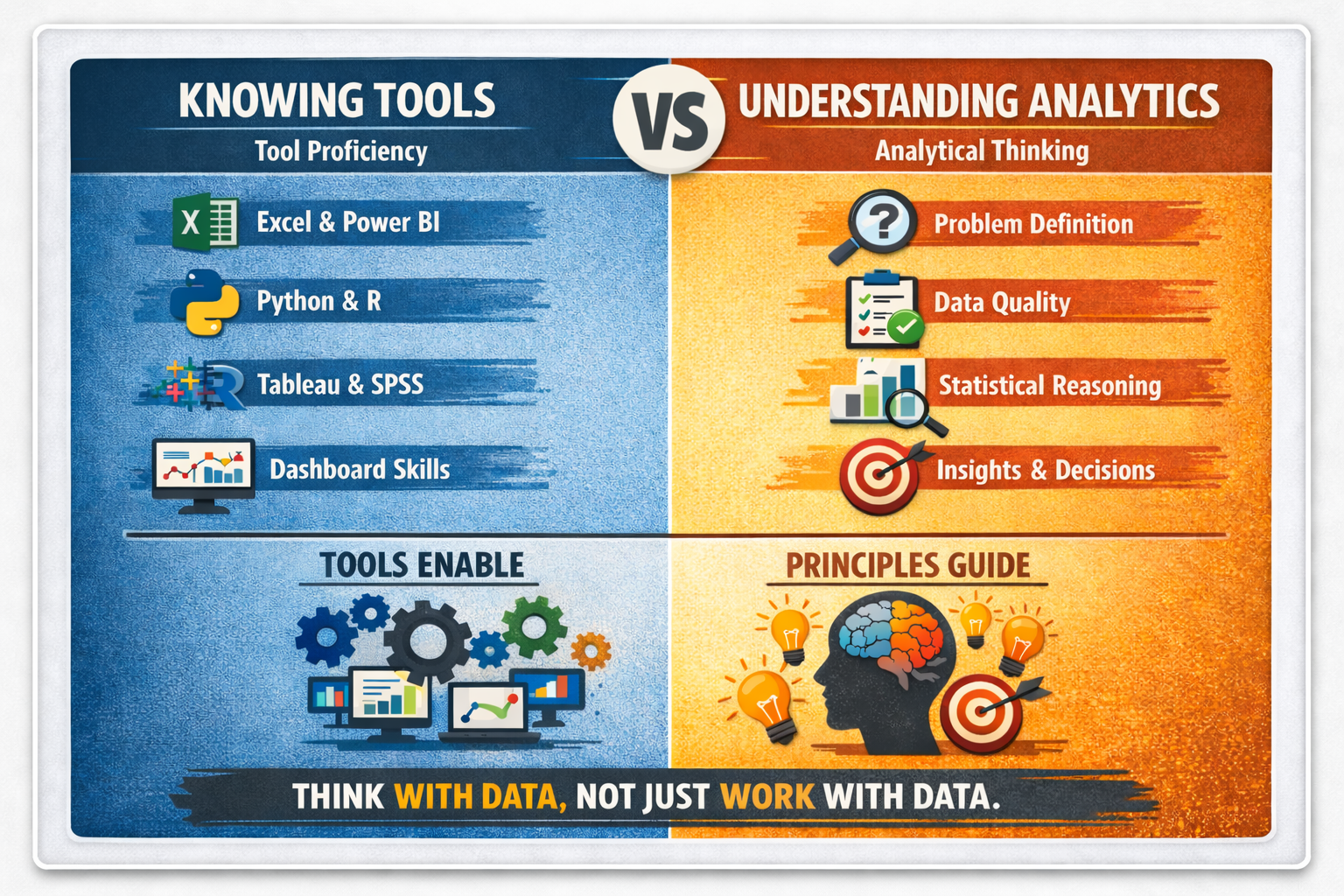
In today’s data-driven world, it has become common to equate data analytics with the ability to use tools such as Excel, Power BI, Python, R, SPSS, or Tableau. Job descriptions, training adverts, and even academic programmes often emphasize tool proficiency as the defining feature of a data analyst. While tools are undeniably important, this mindset reflects a fundamental misunderstanding of what data analytics truly is.
Data analytics is not about tools first. It is about thinking.
The Tool-Centric Misconception
Many people believe that once they can build dashboards, write formulas, or run scripts, they are “doing data analytics.” This is similar to assuming that knowing how to operate a calculator makes one a mathematician, or that owning a stethoscope makes one a doctor. Tools enable work, but they do not define expertise.
A person may be highly skilled in Excel or Power BI and still struggle to answer basic questions such as:
• What problem are we trying to solve?
• What data is relevant and what data is noise?
• What assumptions are embedded in this analysis?
• What decision should be taken based on these results?
Without the ability to answer these questions, analytics becomes mechanical rather than meaningful.
Data Analytics as a Way of Thinking
At its core, data analytics is a disciplined way of reasoning with data to support decisions. It involves understanding how data is generated, how it reflects real-world processes, and how it can be transformed into insight.
Key principles underpinning data analytics include problem formulation, hypothesis thinking, data quality assessment, analytical reasoning, interpretation, and communication. These principles guide the analyst long before a tool is opened and long after charts are produced.
For example, defining the wrong problem leads to perfectly executed but useless analysis. No amount of technical sophistication can compensate for poor analytical framing.
The Importance of Analytical Principles
Understanding the principles of data analytics allows analysts to work across tools, industries, and contexts. Tools change rapidly. Principles endure.
Some foundational principles include:
• Problem-driven analysis: Analytics begins with a clear decision or question, not with available data or flashy visuals.
• Data validity and reliability: Analysts must evaluate whether data is accurate, complete, biased, or fit for purpose.
• Logic and reasoning: Correlation does not imply causation, averages can mislead, and outliers matter.
• Contextual interpretation: Numbers only make sense within operational, economic, and social contexts.
• Ethical responsibility: Data can misinform, manipulate, or exclude if used carelessly.
When these principles are weak or absent, analytics becomes a reporting exercise rather than a decision-support function.
Why Tool-Only Analysts Struggle
Professionals who focus exclusively on tools often face limitations. They may produce attractive dashboards that decision-makers do not trust or use. They may struggle when data is messy, incomplete, or ambiguous. They may also find it difficult to adapt when organizations change systems or adopt new technologies.
In contrast, principle-driven analysts can switch tools with relative ease because they understand why an analysis is done, not just how to execute it.
Principles First, Tools Second
This is not an argument against learning tools. Tools matter. However, they should be learned as instruments for applying analytical thinking, not as substitutes for it.
Effective data analytics education and practice should therefore prioritize:
• Analytical problem-solving frameworks
• Statistical and logical reasoning
• Data storytelling and decision communication
• Domain understanding
• Critical thinking and skepticism
Once these foundations are strong, tools become powerful accelerators rather than crutches.
Conclusion
Data analytics is not defined by software proficiency but by the ability to convert data into insight and insight into action. Tools are essential, but they are only as effective as the thinking that guides them.
Organizations and professionals that invest only in tool training risk building capacity without capability. Those that invest in analytical principles build resilience, adaptability, and long-term value.
In the end, tools help you work with data, but principles help you think with data.

kampungbet

From Data Doubt to Digital Dominance: How South Africa Is Winning with AI in Tourism Analytics

south african tourism

🌍 From Data Doubt to Digital Dominance: How South Africa Is Winning with AI in Tourism Analytics

In today’s data-driven economy, African organisations are discovering that artificial intelligence (AI) and advanced analytics aren’t futuristic luxuries , they’re the engines of competitive advantage. One standout story comes from South African Tourism (SAT), which used AI to unify fragmented data, predict trends, and make smarter investments across the country’s tourism ecosystem.

🧩 The Challenge: Too Much Data, Too Little Insight

Like many public agencies and businesses across Africa, South African Tourism was drowning in data but starving for insight. Multiple databases tracked accommodation supply, visitor feedback, and event activity across nine provinces , yet these datasets were scattered, outdated, and inconsistent.

Marketing decisions often relied on partial information or anecdotal evidence, leading to missed opportunities in promoting emerging destinations. SAT needed a single, intelligent view of the tourism landscape, one that could answer key strategic questions such as:

  • Which destinations are trending among international travellers?

  • Where should investment and infrastructure be prioritised?

  • How are sustainability and local experiences influencing traveller choices?

🤖 The Solution: Turning Data into Action with AI

To address these challenges, SAT adopted the D/AI Destinations Platform by Data Appeal, a unified analytics and AI-powered system that integrates geolocation data, social sentiment, and event intelligence.

The platform combined over 112,000 points of interest and analysed millions of digital traces from online reviews, location tags, and social media posts across South Africa. Using machine learning and natural-language processing (NLP), the AI model identified trends, opportunities, and emerging hotspots for tourism development.

This marked a major transformation, from traditional reporting (“What happened?”) to predictive decision-making (“What’s coming next?”).

📈 The Results: Evidence-Based Strategy in Action

The results were remarkable:

Smarter resource allocation – SAT could now identify underperforming regions and direct marketing funds more strategically.
Real-time sentiment tracking – AI detected traveller perceptions of destinations, helping to tailor communication and improve service design.
Data-driven inclusivity – Previously overlooked rural and cultural destinations gained visibility, supporting the national goal of balanced tourism growth.
Faster decision-making – The automation of data collection and visualisation cut analysis time dramatically, enabling faster leadership responses.

Ultimately, SAT developed an agile, insight-driven culture – where data became a daily decision-making tool, not just an annual reporting exercise.

🌱 Lessons for Zimbabwe and Other Emerging Markets

South Africa’s success offers valuable lessons for Zimbabwean tourism authorities, SMEs, and research organisations seeking to integrate AI and analytics into their strategies:

  1. Integration beats accumulation – It’s not the amount of data that matters, but how well it’s connected. Linking internal, customer, and market data unlocks powerful insights.

  2. AI amplifies human judgment – Technology doesn’t replace analysts; it empowers them to ask better questions and find faster answers.

  3. Local context is key – AI tools should be trained on local language, culture, and behavioural data to ensure relevance and accuracy.

  4. Action matters more than insight – The true ROI of analytics lies in the organisational decisions it enables – not just in beautiful dashboards.

💡 The Bigger Picture: Africa’s Data-Driven Future

As AI tools become more accessible, Africa’s growth will increasingly depend on how well organisations can turn raw data into real outcomes. From smart cities and retail analytics to public health monitoring and financial inclusion, the continent’s next big transformation will be powered not just by data collection – but by data intelligence.

South Africa’s tourism story proves that when data meets purpose, innovation becomes unstoppable.

✍️ Written by

Brian Johnknox Muyambo
Principal Consultant, Research Matters Harare
Data Analytics & AI Training | Market Research | Business Intelligence

8th Floor ZB Chambers
15 George Silundika Avenue,
Harare, Harare 263
Zimbabwe
Phone: 0719397464
Email: info@dataanalysis.co.zw

Statistical software supply and licencing

How Generative AI is Transforming Business in 2025

How AI Is Revolutionising Customer Experience in Business

Contemporary Trends in Data Analytics: Shaping the Future of Decision-Making

kampungbet

The Triple Threat of Data Analytics

triple threat

The Triple Threat of Data Analytics: Strategy, Insight, and Action

In a world overflowing with data, it’s no longer enough to simply have information—you need to know how to use it strategically. For businesses seeking competitive advantage, data analytics presents a powerful opportunity. But what really drives value isn’t just data—it’s how you strategize, extract insights, and take action.

This is what we call the Triple Threat of Data Analytics:
Strategy. Insight. Action.

1. Strategy: Setting the Direction

Every successful data initiative starts with a clear strategy. This is your roadmap—defining what you want to achieve with your data and how analytics will support those goals.

A strong data strategy includes:

  • Clear business objectives
  • Defined key performance indicators (KPIs)
  • Governance and compliance guidelines
  • The right tools and technologies
  • Alignment between leadership, technical teams, and users

Without a strategy, data projects often become disjointed, delivering fragmented or low-impact results.

2. Insight: Finding the Meaning

Data is only valuable when it’s transformed into insight—meaningful interpretations that tell a story or reveal patterns.

Insight generation involves:

  • Data exploration and visualization
  • Statistical analysis and machine learning
  • Business intelligence dashboards
  • Predictive modeling and scenario planning

The key is to ask the right questions. Don’t just focus on what happened—dig into why it happened, what will happen next, and what should be done about it.

3. Action: Creating Impact

This is where many businesses fall short. Reports are created, dashboards are reviewed, but decisions remain unchanged. Action is the final, critical step.

To turn insight into action:

  • Empower decision-makers with real-time, user-friendly tools
  • Integrate data into daily operations and workflows
  • Foster a data-driven culture where decisions are based on evidence
  • Monitor the impact of decisions and iterate continuously

Analytics must move from the boardroom to the front line—whether that’s in sales, supply chain, customer service, or strategy development.

Why It Matters

Data analytics is evolving. Organizations that can connect the dots between strategy, insight, and action are the ones thriving in today’s digital economy.

Those that don’t? They’re drowning in reports, stuck in “analysis paralysis,” and failing to capitalize on their data assets.

Final Thought

Ask yourself:

  • Are we collecting the right data?
  • Are we producing insights that challenge assumptions?
  • Are we empowering teams to take data-informed actions?

Mastering the triple threat isn’t about chasing the newest analytics tool. It’s about aligning your people, your processes, and your purpose around data.

When strategy, insight, and action work together, your data doesn’t just speak, it leads.

Want to get more out of your data?

We help businesses build effective analytics strategies, uncover powerful insights, and take action that drives real results. Get in touch to discuss your data journey.

Keywords: data analytics, business intelligence, data strategy, actionable insights, predictive analytics, data-driven decisions, big data, data consulting, analytics for business growth


kampungbet

kampungbet

kampungbet

kampungbet

kampungbet

How AI Is Revolutionising Customer Experience in Business

How Generative AI Is Revolutionising Customer Experience in Business

How AI Is Revolutionising Customer Experience in Business

In today’s rapidly digitizing world, businesses are constantly looking for ways to elevate customer experience (CX), not just to meet expectations, but to anticipate and exceed them. Among the most powerful tools reshaping this space is Generative AI, a category of artificial intelligence that creates content, conversation, design, and decision support in real time.

From customer service to product design, generative AI is not just enhancing efficiency, it’s redefining how businesses engage with people.

What is Generative AI?

Generative AI refers to systems capable of creating original outputs , text, images, audio, video, and even code, based on patterns learned from vast datasets. Tools like ChatGPT, DALL·E, and Google’s Gemini are examples of generative AI platforms that can simulate human-like creativity and reasoning at scale.

Why Customer Experience Matters More Than Ever

In an era of commoditized products and abundant choices, experience is what differentiates a brand. Research shows that companies that lead in customer experience outperform their competitors in terms of revenue growth and customer retention. The key challenge? Delivering consistent, personalized, and high-quality service across multiple channels.

How Generative AI is Transforming CX

1. Hyper-Personalized Interactions

Generative AI can instantly generate customer-specific responses based on purchase history, browsing behavior, or real-time context. Imagine a chatbot that remembers a customer’s last inquiry, offers tailored product recommendations, and adjusts its tone to match the customer’s communication style, all autonomously.

2. 24/7 Intelligent Customer Support

Traditional chatbots were rule-based and often frustrating. Now, AI-powered virtual agents can handle complex queries, escalate issues when necessary, and even simulate empathy, providing a more humanized support experience without the wait times.

3. Smarter Product Descriptions and Content

Generative AI can dynamically generate product descriptions, marketing emails, and FAQs that match a user’s preferences. This allows e-commerce businesses, for example, to speak directly to different personas without manually rewriting content.

4. Voice and Visual AI Interfaces

AI voice assistants are becoming more natural and responsive. Meanwhile, image-based AI can help customers “try on” clothes virtually, scan real-world objects for information, or design custom furniture with a prompt. These features merge AI creativity with real customer value.

5. Real-Time Feedback and Sentiment Analysis

Generative AI can sift through customer reviews, social media mentions, and support tickets to identify pain points and recommend service improvements. It doesn’t just collect data, it interprets and translates it into actionable insights.

Challenges and Ethical Considerations

Despite its promise, the rise of generative AI brings challenges:

  • Bias and hallucinations: AI can generate misleading or biased content if not trained responsibly.
  • Privacy concerns: Handling customer data must comply with global data protection standards (e.g., GDPR, POPIA).
  • Human touch: While AI enhances scale, human oversight is essential in emotionally sensitive or high-stakes interactions.

Businesses must blend automation with empathy, and use AI to enhance human capabilities, not replace them.

Looking Ahead: Augmented CX Teams

The future is likely to see hybrid teams where humans and AI collaborate seamlessly. Generative AI will handle repetitive and predictive tasks, freeing up employees to focus on creativity, strategic thinking, and building relationships.

Companies that invest in AI literacy, ethical frameworks, and customer-centric design today will be the CX leaders of tomorrow.

Conclusion

Generative AI is not just a trend, it’s a foundational shift in how businesses can deliver value. Those who embrace it thoughtfully and strategically will redefine what’s possible in customer experience.

Are you ready to unlock the full potential of AI in your business?

Need help integrating AI into your customer experience strategy? Contact us for a consultation.

Name

How Generative AI is Transforming Business in 2025

Artificial Intelligence (AI) Training Courses

How AI is Revolutionizing Weather Forecasting?

Data security in collaborative data analytics

8th Floor ZB Chambers
15 George Silundika Avenue,
Harare, Harare 263
Zimbabwe
Phone: 0719397464
Email: info@dataanalysis.co.zw

kampungbet

kampungbet

kampungbet

kampungbet

kampungbet

kampungbet

kampungbet

kampungbet